ADAS calibration reduces avoidable collision-shop risk by replacing assumptions with a VIN-specific procedure, a documented trigger, and an identifiable result. It does not erase liability or guarantee every related function. The strongest repair file separately shows the scan, calibration requirement, prerequisites, outcome, and any unresolved limitation.
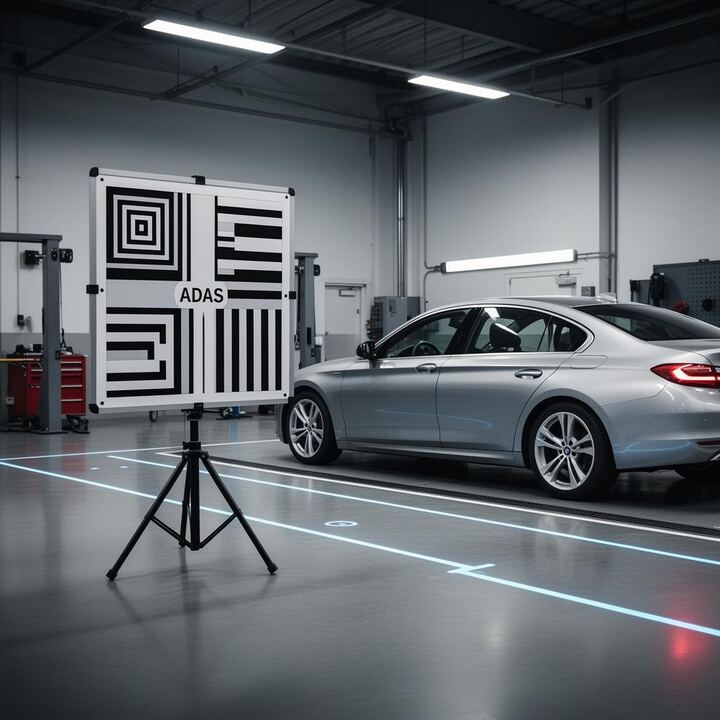
ADAS calibration reduces a collision shop's avoidable repair risk when the file shows why the operation was required, which vehicle-specific procedure governed it, whether the vehicle met the prerequisites, and what result was obtained. It does not create legal immunity. It creates a reproducible technical record instead of leaving a safety-related decision supported only by assumption.
That distinction matters because calibration concerns physical aim and learned reference, not only electronic communication. I-CAR explains that a one-degree aiming error can move a camera or sensor's effective view by many feet at distance and can keep a related function from responding as designed. I-CAR's exact one-degree article connects a small mounting change to a potentially large sensing error.
What repair risk is calibration actually controlling?
The practical risk is an unverified gap between the repaired vehicle and the procedure that applies to it. A module can communicate, a warning lamp can remain off, and a sensor can look centered while its physical or learned reference is still outside the required process. Calibration addresses the reference defined by the OEM procedure for the identified component and repair event.
The systems that use those inputs have measurable safety value. IIHS reports that automatic emergency braking reduces police-reported rear-end crashes by 50 percent. IIHS also found that post-repair issues were reported by some owners after work involving crash-avoidance features. In its published study abstract, about half of respondents whose damaged vehicles had calibration performed reported a persisting feature issue. Those results do not identify the cause of any individual problem and do not prove negligence. They do show why a shop should treat the calibration decision as a documented repair-planning issue rather than a delivery-day guess. IIHS's repair overview and the related research abstract provide the scope and limitations of those findings.
For an estimator, the useful question is not, "Could this feature matter?" The useful questions are:
- Which camera, radar, steering, or other input is installed on this VIN?
- What repair event affected that input or its mounting reference?
- Which current procedure states the required next operation?
- What condition must be true before that operation can start?
- What evidence will distinguish completion, failure, or a blocked procedure?
Why is a completed calibration not a blanket safety guarantee?
A calibration result supports the named operation on the named system. It does not prove unrelated body dimensions, glass installation, bracket condition, wheel alignment, coding, diagnostics, or functional checks. It also does not establish the legal outcome of a future claim.
That limit should appear in the repair workflow. If a forward camera requires calibration after windshield replacement, the result does not by itself prove that the glass, camera bracket, tire condition, or diagnostic state was correct. Those are separate facts unless the governing procedure makes them part of the calibration and the returned record shows they were checked.
A strong file therefore avoids two opposite errors:
- Overclaiming: treating one successful result as proof of the entire repair.
- Under-documenting: recording only that a vendor visited, without identifying the procedure, system, method, or outcome.
The repair record should say exactly what the result establishes. If a procedure did not complete, the record should say so. If an unresolved condition remains, it should be carried as an open repair issue rather than converted into a pass.
Why does a clean scan not close the calibration question?
Scanning and calibration answer different questions. I-CAR defines pre-repair scanning as code capture used in damage analysis and post-repair scanning as a quality-control process for identifying and clearing diagnostic trouble codes. It separately describes calibration or initialization as aiming, setup, relearn, zero-point work, or another required operation following work on affected parts. I-CAR also warns that many sensors or modules do not know they were replaced or that calibration is required. The exact I-CAR scan-versus-calibration article is the controlling source for that distinction.
This creates four separate evidence categories:
- Diagnostic status: what the pre-scan or post-scan found.
- Procedure requirement: what the current OEM information says the repair event requires.
- Calibration status: whether the named aiming, setup, or learning process completed.
- Remaining repair status: whether any prerequisite, fault, damage, or limitation is still open.
Collapsing those categories into "ADAS checked" makes the file harder to review. Keeping them separate lets an estimator, technician, manager, or reviewer reproduce the decision without guessing what the phrase meant.
What should the blueprint show before the vehicle enters production?
The blueprint should connect the trigger to the operation. A useful sequence is:
- Identify the installed component by VIN and vehicle configuration.
- Record the actual repair event, such as removal, replacement, adjustment, mounting-area damage, glass work, fascia work, or a diagnostic instruction.
- Capture the title, section, or document identifier for the current OEM procedure.
- List the prerequisites that affect production order, such as final glass, final bumper finish, completed structural work, alignment status, ride height, tire condition, loading, or resolved faults.
- Name the calibration, initialization, coding, scan, or test operations separately when the procedure separates them.
- Define what result must return to close each operation.
I-CAR's windshield research article is useful for finding sensor locations and trigger events, and it says its search result can be printed to document the next steps. The same article explicitly states that the search does not contain the calibration procedure and cannot replace OEM repair information. I-CAR CRN-801 therefore supports a two-stage process: use research to locate the requirement, then retain the actual procedure that governs the work.
How should the shop handle a procedure that cannot be completed?
An incomplete calibration is not a successful calibration with a note attached. It is a different status that should drive a different production decision.
The closeout vocabulary should be unambiguous:
- Completed: the named procedure reached its defined successful result.
- Failed: the procedure ran but returned a failure or did not achieve the required result.
- Blocked: a prerequisite, vehicle condition, environment, access limitation, or unresolved fault prevented the procedure from being performed as directed.
- Not required: current vehicle-specific information was reviewed and did not require the operation for the documented repair event.
- Not researched: the file does not yet contain enough information to decide.
Those labels prevent appointment completion from being confused with technical completion. A technician's arrival, a connected diagnostic session, or a road attempt is not the result. The repair plan should also name who owns the next action, such as correcting alignment, repairing a bracket, completing refinishing, resolving a fault, or rescheduling under suitable conditions.
What belongs in a reviewable calibration record?
A useful repair-file packet lets another qualified person answer the same questions later. It should include:
- VIN, make, model, model year, and relevant installed-system identification.
- The collision or repair event that triggered research.
- The exact current procedure or document reference and its retrieval date.
- The named camera, radar, sensor, or system.
- Required method and prerequisites stated by the procedure.
- Relevant pre-scan findings and prerequisite status.
- Calibration start and completion status, with an identifiable result.
- Relevant post-scan findings and any remaining diagnostic condition.
- Photos or measurement records when they support required setup or mounting facts.
- A plain statement of any failure, blocker, exception, or follow-up action.
The packet should preserve source scope. A bulletin limited to one model range should not be presented as a make-wide rule. A general I-CAR article should not be labeled as the vehicle's calibration procedure. The current VIN-specific instruction remains the load-bearing repair source.
How can the estimator reduce risk before dispatch?
Before a mobile appointment is booked, the estimator can run a short decision gate:
- Has the VIN and actual repair operation been supplied?
- Is the affected component installed and its mounting area complete?
- Are glass, fascia, refinish, structural, suspension, and alignment operations at the stage required by the procedure?
- Are tire pressure, tire size, loading, fuel, and ride-height conditions known when relevant?
- Have blocking faults or communication problems been identified?
- Is the work area suitable for the required stationary process, or is road access available for the directed driving process?
- Is the expected result packet defined before the job begins?
Focal ADAS can review the VIN, repair event, and procedure context before scheduling a mobile calibration request. The shop can send that information to service@focaladas.com or call (206) 460-0999. The response should confirm the proposed scope, prerequisites, and evidence to return, not promise that an uninspected vehicle will pass.
Frequently asked questions
Does calibration remove a collision shop’s liability?
No. A properly researched and documented calibration can reduce avoidable repair-file uncertainty, but it cannot provide legal immunity or prove the entire vehicle repair. Legal conclusions depend on the facts and the shop’s qualified counsel.
Why is one degree of sensor movement important?
I-CAR explains that a one-degree aiming change can produce a miss of many feet as distance increases. The estimator should treat bracket, glass, structure, and mounting changes as procedure-research events rather than judging aim by appearance.
Can a clean scan serve as the calibration record?
No. A scan records diagnostic information, while a calibration result records the outcome of an aiming, setup, or learning operation. Both may belong in the file, but neither should be relabeled as the other.
What should a risk-focused calibration file contain?
The file should connect the VIN, named system, repair trigger, current procedure, prerequisites, method, result, diagnostic findings, and any limitation. It should also distinguish a blocked or failed procedure from a completed result.
Does a calibration result prove every ADAS repair is correct?
No. The result supports only the operation and system it identifies. Related replacement, alignment, coding, scanning, diagnosis, and functional checks remain separate repair decisions unless the governing procedure explicitly combines them.
Sources
- I-CAR, Even One Degree: ADAS Calibration, CRN-1389 https://rts.i-car.com/crn-1389.html
- I-CAR, The Differences Between Scanning and Calibration, CRN-843 https://rts.i-car.com/crn-843.html
- IIHS, Crash avoidance features improve safety but complicate repairs https://www.iihs.org/news/detail/crash-avoidance-features-improve-safety-but-complicate-repairs
- IIHS, Consumer experiences with crash avoidance feature repairs https://www.iihs.org/research-areas/bibliography/ref/2274
- I-CAR, Calibration After Windshield Replacement, CRN-801 https://rts.i-car.com/crn-801.html
Focal ADAS handles it on-site, same day, from Seattle to Tacoma.
Put calibration on autopilot.
Request a calibration in 60 seconds. A reply with an arrival window comes back within the hour.