Yes. ADAS can require calibration without a warning light because dashboard indicators, diagnostic codes, physical aiming, and calibration results are different evidence. The vehicle-specific procedure determines whether the repair event requires calibration. The repair file should record that requirement and an identifiable outcome even when the instrument panel remains quiet.
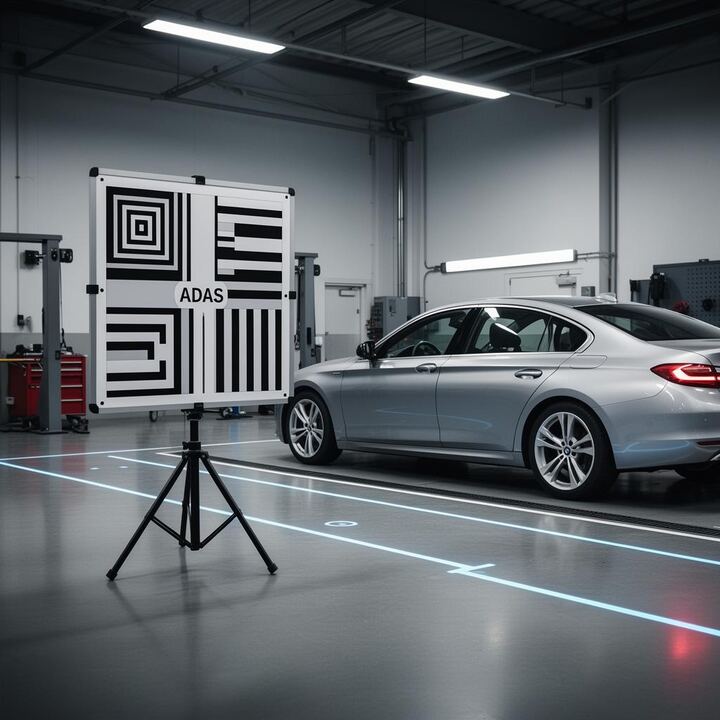
A quiet dashboard does not prove that an ADAS calibration was required, performed, or completed. Warning lamps, diagnostic trouble codes, physical sensor aim, and calibration results are different evidence. The vehicle-specific procedure determines whether the documented repair event requires aiming, setup, relearn, or another operation.
That distinction is directly supported by an OEM bulletin. A MINI service bulletin covering specified camera-based systems says several operating limitations can occur without relevant stored fault codes. It lists incomplete calibration, unsuccessful calibration, a dirty windshield, restricted visibility, lighting, weather, and tire conditions. It also states that no faults are stored during the calibration period and that calibration is needed after windshield replacement for the covered applications. The exact NHTSA-hosted bulletin is narrow to its stated vehicles, but it disproves the shortcut that no code always means no calibration issue.
What does a warning light actually tell the estimator?
A warning light tells the estimator that the vehicle has recognized and chosen to display a condition. It does not inventory every sensor affected by the repair. It does not identify every procedure trigger. It does not confirm physical aim. It does not prove that a calibration routine reached its successful result.
The dashboard can still be useful evidence. A warning, message, or unavailable-function notice should be captured and connected to diagnostic research. The error is using the absence of that evidence as permission to skip the OEM procedure search.
The file should answer four different questions:
- Did the vehicle display a warning or message?
- Did diagnostic scanning find a related code or communication issue?
- Did the repair event trigger a calibration requirement in current service information?
- Did the required operation complete with an identifiable result?
Only the third question decides whether the repair event requires calibration. Only the fourth closes that calibration line.
Can calibration be required when no diagnostic code is present?
Yes. I-CAR explains that scanning and calibration are separate operations and notes that sensors or modules often do not know they were replaced or that calibration is required. A scan captures diagnostic information. Calibration includes aiming, module setup, relearn, zero-point work, initialization, or another process directed after work on affected parts. I-CAR's exact scan-versus-calibration article tells repairers to identify the actual processes and, when possible, the OEM procedure rather than use the terms interchangeably.
A repair trigger can therefore exist without a code. Examples of trigger categories that require research include:
- A windshield, camera, radar unit, or mounting bracket was removed or replaced.
- A bumper cover, grille, mirror, liftgate, or body part that locates a sensor was removed, installed, repaired, or adjusted.
- A collision affected the sensor, bracket, mounting surface, or nearby structure.
- Alignment, ride height, rear toe, steering, or suspension work changed a reference used by the system.
- The OEM diagnostic path or component procedure explicitly directs calibration.
Those are research categories, not universal calibration mandates. The current VIN-specific procedure decides which event applies to the actual vehicle.
Why can physical aim be wrong while electronics appear normal?
A camera or radar component can remain powered, connected, and able to communicate while its viewing direction has shifted. I-CAR states that a one-degree error can cause a sensor or camera to miss a target by many feet depending on distance. It also says the related system may not respond as designed when the component is not aligned to the specified measurement. I-CAR CRN-1389 provides the physical basis for treating mounting geometry separately from code status.
This is why a visual check is not a calibration result. A bracket may look straight. A camera may snap into place. A radar unit may sit behind an undamaged-looking fascia. None of those observations establishes the measurements, setup, or learned values required by the procedure.
The estimator should capture the physical event that creates the research need. "Camera replaced" is stronger than "ADAS light off." "Radar bracket repaired" is stronger than "no codes." The repair event is reproducible; the absence of a warning is only one condition observed at one time.
How are programming, configuration, calibration, and scanning different?
These operations can appear near each other in service information but should not be merged unless the procedure merges them. A General Motors bulletin limited to specified 2019 pickups says its front-camera event required module programming, module configuration, and module calibration as three steps. The exact NHTSA-hosted GM bulletin is not a rule for other vehicles, but it provides a concrete example of separate electronic operations within one repair sequence.
For estimate and closeout purposes:
- Scanning captures diagnostic status.
- Programming installs or updates software or data when directed.
- Configuration or coding identifies the installed vehicle or component variant when directed.
- Calibration establishes the required physical or learned reference.
- Functional verification checks operation through the procedure specified by the OEM.
One successful step does not automatically prove the others. A programming success message is not a camera-aim result. A clean post-scan is not a coding record. A completed calibration is not proof that every related function passed a separate test.
What should replace the warning-light shortcut in the repair plan?
The replacement is a trigger-to-result chain. The shop can use this sequence:
- Record the VIN and installed system or affected component.
- Record the exact repair event, including removal, replacement, adjustment, bracket work, glass work, bumper work, alignment, or collision impact.
- Retrieve the current vehicle-specific procedure and document its title or identifier.
- List every directed prerequisite and separate operation.
- Schedule calibration only when the vehicle is in the required state.
- Retain the identifiable outcome and any limitation.
- Perform and document the separate closeout steps directed by the procedure.
I-CAR's windshield article explains that its calibration search can identify sensor locations and events such as glass or camera removal and replacement. The same article says the research output cannot replace the OEM procedure. I-CAR CRN-801 supports using the research result to locate and document the requirement, followed by the actual instruction for performance.
Which status words keep the file honest?
Ambiguous wording creates unnecessary risk. "Checked," "reset," "no light," and "ADAS good" do not tell a reviewer what occurred. The repair file should use a status that can be tested against evidence:
- Required and completed: the procedure called for the operation and the returned result shows success.
- Required and failed: the operation was attempted but did not reach the required result.
- Required and blocked: a prerequisite, fault, setup condition, or environment prevented completion.
- Researched and not required: current service information did not require the operation for the documented event.
- Decision pending: the VIN, configuration, repair event, or procedure has not been resolved.
The wording should name the component. "Forward-camera calibration completed" is reviewable. "ADAS done" is not.
What evidence should close a no-warning-light job?
For a vehicle with a quiet dash, the completion packet should still show:
- The VIN and named component.
- The repair event that triggered research.
- The current procedure or document reference.
- The required method and prerequisites.
- Relevant diagnostic findings before and after work.
- An identifiable calibration result or a clear statement that the procedure was not required.
- Any failed, blocked, or deferred step.
The dashboard condition can be included, but it should not be promoted above the procedure and result. When Focal ADAS reviews a mobile request, the shop can send the VIN, repair event, relevant scans, and procedure reference to service@focaladas.com or call (206) 460-0999. The scheduling response should identify what information is still missing before the operation can be scoped.
Frequently asked questions
Can an ADAS calibration be required with no warning light?
Yes. A vehicle-specific procedure can require calibration after a named repair event even when the instrument panel shows no warning. The trigger comes from the current procedure, not from waiting for the vehicle to display a lamp.
Does no diagnostic trouble code mean the camera is aimed correctly?
No. Diagnostic status and physical aim are different conditions. A clean scan can be useful closeout evidence, but the calibration requirement and result must be verified separately when the procedure calls for aiming or learning.
What proves that calibration finished?
The file should retain an identifiable result tied to the VIN, named system, procedure, and performed method. A screen showing only that calibration mode started or that a command was issued is not the same as a completed result.
Are dashboard warnings irrelevant to ADAS repair?
No. Warning lamps and diagnostic codes can direct diagnosis and should be documented. They are simply not a complete substitute for procedure research, physical inspection, calibration evidence, or other required closeout work.
What should an estimator do when the dash is quiet after glass work?
The estimator should identify the windshield camera and research the exact glass and camera procedures for the VIN. The file should then show whether calibration was required, which prerequisites applied, and what result was returned.
Sources
- MINI service bulletin, camera-based driver-assistance limitations, NHTSA document MC-10179018-9999 https://static.nhtsa.gov/odi/tsbs/2020/MC-10179018-9999.pdf
- I-CAR, The Differences Between Scanning and Calibration, CRN-843 https://rts.i-car.com/crn-843.html
- I-CAR, Even One Degree: ADAS Calibration, CRN-1389 https://rts.i-car.com/crn-1389.html
- General Motors bulletin, three-step front-camera process, NHTSA document MC-10173960-9999 https://static.nhtsa.gov/odi/tsbs/2020/MC-10173960-9999.pdf
- I-CAR, Calibration After Windshield Replacement, CRN-801 https://rts.i-car.com/crn-801.html
Focal ADAS handles it on-site, same day, from Seattle to Tacoma.
Put calibration on autopilot.
Request a calibration in 60 seconds. A reply with an arrival window comes back within the hour.