Static calibration uses physical targets placed at exact distances and angles in a controlled space. Dynamic calibration uses a structured road drive at set speeds. Many modern vehicles require both, in a specific order.
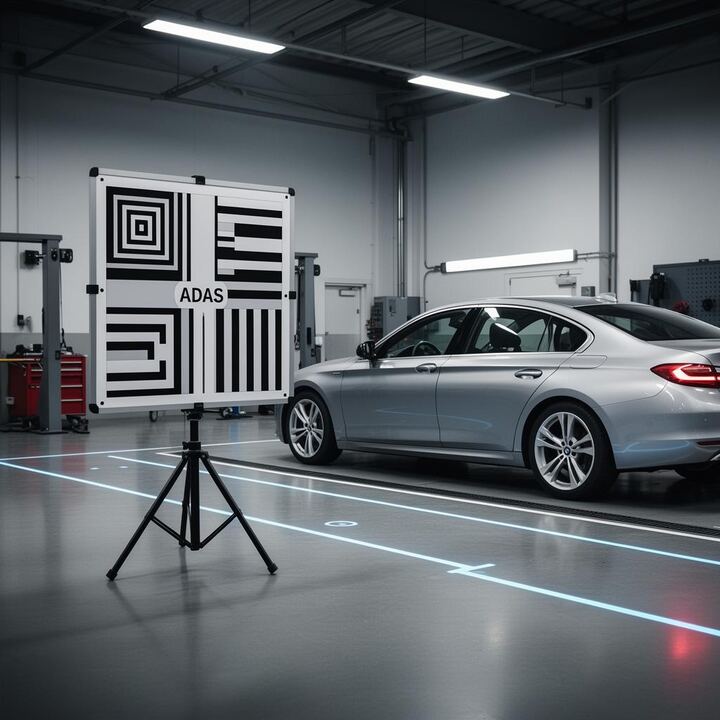
When a calibration is scheduled, the first question is almost always the same: does this vehicle need a static calibration, a dynamic one, or both? The answer changes the time on-site, the space required and the documentation on the file.
Static calibration
A static calibration is performed with the vehicle stationary in a controlled space. Physical targets (printed boards, radar reflectors, mirror panels) are placed in front of, beside or behind the vehicle at distances and angles the manufacturer specifies down to the millimeter. The scan tool then drives the sensor through an alignment routine while it reads those known references.
It is the right approach when the sensor needs an absolute reference to lock onto, when ambient light cannot be relied on, or when the OEM procedure simply does not offer a drive option.
Dynamic calibration
A dynamic calibration is performed on a public road, with the scan tool active and the vehicle driven at specific speeds for a specific distance. The sensor learns its environment from lane lines, road furniture and surrounding traffic.
It is the right approach when the manufacturer's procedure explicitly calls for it, and when road and weather conditions match the OEM's stated minimums for lighting, lane marking quality and traffic density.
When a vehicle needs both
Many newer vehicles require static first, then dynamic. The static pass sets the baseline, and the dynamic pass confirms the system performs against the real world. Skipping the second step leaves the calibration technically incomplete, even if the scan tool reports success after the static stage.
What this means for your shop
The honest version is: it is not your job to memorize which vehicle needs what. It is the calibration vendor's job to look up the OEM procedure for that exact VIN and perform the right combination. What you should expect on the report is a clear statement of which procedures were performed and the OEM reference they came from.
Focal ADAS handles it on-site, same day, from Seattle to Tacoma.
Put calibration on autopilot.
Request a calibration in 60 seconds. A reply with an arrival window comes back within the hour.