Audi ADAS calibration requirements depend on the VIN, fitted systems, repair event, and verified vehicle geometry. Windshield, camera, bumper, radar, suspension, and alignment work can change the required sequence. Audi also distinguishes a complete alignment from a quicker geometry check, but either path must establish a correct thrust angle before affected systems are calibrated.
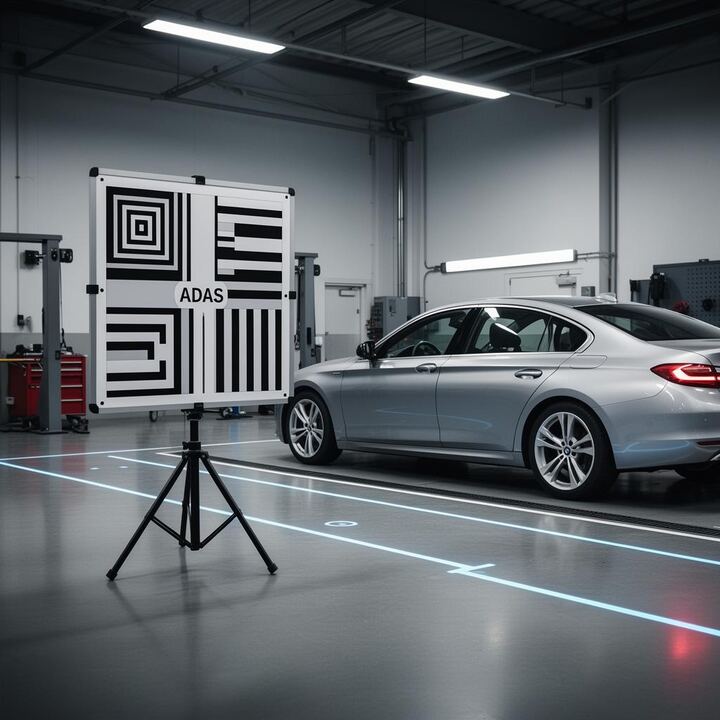
Audi ADAS calibration requirements depend on the VIN, fitted driver-assistance systems, repair event, and verified vehicle geometry. Camera, windshield, bumper, radar, suspension, alignment, or surround-view work can lead to different procedures. The make-specific scheduling issue is that the correct thrust angle must be established before affected systems are calibrated.
Audi's procedures also place unusual emphasis on calibration conditions. Windshield type, camera mounting, dirt, reflections, shadows, ride height, and camera-field obstructions can make a technically ready vehicle fail the procedure. Those conditions should be checked before the calibration appointment rather than discovered after setup.
Where does Audi organize driver-assistance repair information?
I-CAR's Audi repair-manual guidance says Audi began adding a separate Driver Assistance Systems publication to many model manuals in 2019. It brings together sensor locations, operating descriptions, component procedures, calibration instructions, required resources, and safety information.
The estimator should use that manual as part of a wider VIN-specific search:
- Identify the installed camera, radar, sensor, or controller.
- Connect the collision operation to the component and its mounting or field of view.
- Determine whether complete alignment, a quicker geometry check, calibration, configuration, or diagnostics applies.
- Record the exact prerequisites and result evidence.
The 2019 reference describes Audi's information structure for many models. It does not mean every later Audi carries the same system or calibration method.
Does Audi require a full alignment before every calibration?
No. I-CAR's Audi wheel-alignment clarification reports two paths: a complete alignment and a quicker access procedure. Audi gave rear-axle toe adjustment and a suspension-type change as examples for complete alignment. Front-bumper removal, replacement, loosening, adjustment, or damage were examples for the quicker path.
The non-negotiable point is the thrust angle. Audi's clarification says either method requires a true thrust angle before calibration. That makes the estimator's repair context important. A shop should not automatically add a full alignment to every bumper job, but it also should not send a vehicle directly to calibration without the geometry check required by the procedure.
A clear estimate should state:
- What collision or suspension operation occurred.
- Which alignment or quick-check path applies.
- Whether correction was needed.
- Which systems require calibration afterward.
- What alignment and calibration records will close the file.
That sequence prevents a calibration attempt from being used as a substitute for unresolved vehicle geometry.
What can block Audi forward-camera calibration after glass work?
A NHTSA-hosted Audi front-camera bulletin covers stated ranges of Q7 and SQ7, A4-family, A5-family, Q5, and SQ5 vehicles from the 2016-2020 period. It addresses calibration requests and specified diagnostic conditions, then instructs the technician to read faults and follow guided diagnostics and the repair manual.
The bulletin identifies several calibration concerns: an incorrect windshield, dirt in the camera's field of view, the condition and installation of the camera interface pad, strong light or sunshine on the camera or calibration panel, and panel-distance or recognition errors. It also says a removed camera needs a new interface pad. Those facts belong to the bulletin's stated applications, but they show why glass and setup details are material estimate and scheduling inputs.
Before scheduling, the shop should confirm the correct windshield, clean viewing area, final camera and bracket installation, correct ride height, and a workspace that can control direct light and reflections. If calibration fails, the file should preserve the actual error and corrective step rather than jumping to unsupported parts replacement.
Why can Audi surround-view calibration fail in a prepared bay?
The NHTSA-hosted Audi overhead-view camera bulletin covers broad stated ranges of A6, A7, A8, Q7, Q8, and related variants from the 2018-2024 period. It describes failures caused by incorrect setup or camera correction values outside tolerance.
The service guidance requires the calibration fixture to match the workshop-manual setup and says lighting must leave its lines clearly recognizable without reflections or shadows. Later sections address camera installation, ride-height discrepancies, and level-sensor installation when calibration remains unsuccessful. This is a strong example of why overhead-view work requires more than an open floor.
The estimate and handoff should identify the affected camera, body part, ride-height state, prior camera installation, lighting control, and any displayed calibration error. The schedule should reserve a suitable bay and time for correction if the procedure rejects one of those conditions.
What Audi bumper restrictions can affect radar operation?
I-CAR's current Audi bumper-cover guidance reports that front-bumper trim in front of adaptive-cruise radar must not be painted during repair or replacement refinishing. For lane-change radar areas, it lists a 150-micron coating limit, no plastic repair or filler within 25 cm, no three-coat painting, and no spot repair over the sensor field.
The same guidance says the entire radar field should be sanded to plastic during a repair and cleared across the full field, with the vehicle-specific paint manual showing the sensor area. Those restrictions need review before the shop chooses a repair strategy. Calibration cannot correct excessive coating, filler, or a prohibited localized repair in the radar path.
The final repair file should document the radar field, prior refinishing, coating decision, bumper geometry, required quick or complete alignment path, calibration result, and diagnostic status.
How should Audi scanning be stated accurately?
Audi does not publish a separate scanning position statement, but I-CAR's current Audi scanning guidance cites Audi's Safety Precautions and Repair Information. Its collision instructions call for reading diagnostic memory, resolving recorded entries, and repeating the applicable system checks after repairs.
The repair order should preserve that distinction. It can cite the current Audi service instruction without mislabeling it as a stand-alone position statement. Scan results remain separate from alignment proof and geometric calibration evidence.
Audi glass work belongs with forward camera calibration, while a radar-area fascia repair should connect to front radar calibration. Overhead-view jobs can use 360 camera calibration, and thrust-angle planning can reference alignment and steering-angle reset.
For scheduling, the shop should send the VIN and repair context to service@focaladas.com or call (206) 460-0999. Focal ADAS confirms the current OEM procedure, calibration method, and site requirements before the appointment.
Frequently asked questions
Does every Audi calibration require a complete wheel alignment?
No. Audi distinguishes a complete alignment from a quicker geometry-check path based on the work performed. I-CAR reports that both paths still require a correct thrust angle before calibration, so the current vehicle procedure controls the choice.
Can Audi front-bumper removal require a geometry check?
Yes. Audi gave front-bumper removal, replacement, loosening, adjustment, or damage as examples for the quicker alignment-access path. The shop should document the check and any correction before the affected driver-assistance calibration.
Can lighting cause an Audi camera calibration failure?
Yes. Audi bulletins identify direct light, reflections, shadows, and unclear calibration markings as failure factors for specified camera procedures. The workspace and viewing area should be prepared to the applicable manual before setup begins.
Can an Audi radar-field bumper area receive a spot repair?
Audi guidance reported by I-CAR prohibits spot repair over specified radar fields and adds coating-thickness, filler, plastic-repair, and paint-system restrictions. The exact field and repair process must come from the current vehicle paint information.
Does Audi publish a separate pre-scan and post-scan position statement?
No separate position statement is identified by I-CAR. Audi Safety Precautions and Repair Information nevertheless directs diagnostic-memory checks, correction of entries, and another check of the affected systems after repair.
Sources
- I-CAR Audi Driver Assistance Systems repair-manual guidance https://rts.i-car.com/crn-1327.html
- I-CAR Audi wheel-alignment and ADAS clarification https://rts.i-car.com/crn-1605.html
- I-CAR Audi bumper-cover repair guidance for ADAS https://rts.i-car.com/crn-2368.html
- I-CAR Audi pre-repair and post-repair scanning guidance https://rts.i-car.com/crn-2405.html
- NHTSA-hosted Audi front-camera calibration bulletin https://static.nhtsa.gov/odi/tsbs/2020/MC-10181436-0001.pdf
- NHTSA-hosted Audi overhead-view camera bulletin https://static.nhtsa.gov/odi/tsbs/2023/MC-10233617-0001.pdf
Focal ADAS handles it on-site, same day, from Seattle to Tacoma.
Put calibration on autopilot.
Request a calibration in 60 seconds. A reply with an arrival window comes back within the hour.