Always, at minimum a steering angle sensor reset, and on many vehicles a camera or radar calibration as well. An alignment changes how the wheels sit relative to the steering wheel and to the road, which invalidates the steering angle reference and can change how the forward camera and radar aim. The exact requirement is set by the manufacturer for the specific vehicle.
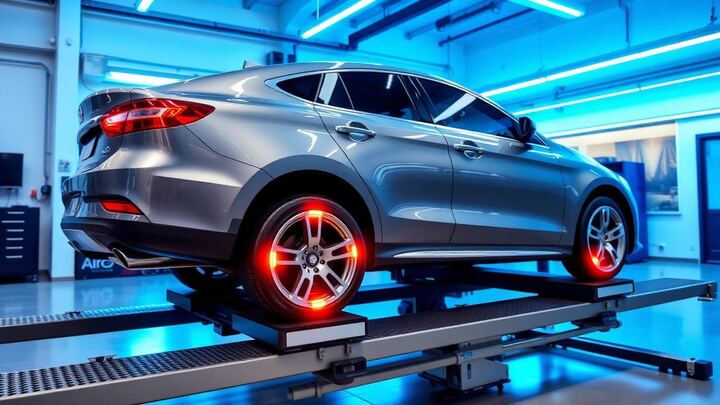
Why an alignment always ends with a steering angle reset
The steering angle sensor reports, many times a second, the exact angle of the steering wheel relative to a zero point. Stability control, lane keeping, and adaptive cruise all read that value to know what the driver intends. An alignment rack zeroes the suspension, not the sensor, so the sensor has to be told with a scan tool that the new straight ahead is straight ahead. Hunter Engineering notes that roughly 45 percent of vehicles in North America, more than 140 million, require a steering angle sensor reset after an alignment, and warns that failing to perform the required safety-system procedure "may impact the proper operation of electronic driver-assist systems" (Hunter Engineering).
When an alignment also means a camera or radar calibration
This is the part most estimates miss. Changing the alignment changes the vehicle's thrust angle and can change ride height, and the forward camera and radar are aimed relative to the direction the vehicle actually travels. I-CAR published dedicated guidance on this, noting that radar systems in particular can require calibration after an alignment because the thrust angle changes (I-CAR RTS, ADAS Calibrations After Wheel Alignment). Whether a given alignment triggers a full camera or radar calibration is make-specific, which is why it is verified per VIN rather than assumed either way.
What the manufacturers say
The manufacturers who address alignment are specific. Nissan requires that "after any ADAS component removal, replacement, and even vehicle alignment, the proper calibration procedure must be performed" (Nissan, via I-CAR RTS). Audi distinguishes cases, calling for a full alignment before calibration when "the rear axle toe was adjusted" or "the vehicle suspension was changed," and requiring that "the thrust angle is true before doing the calibration" in every case (Audi, via I-CAR RTS). The pattern is consistent: the sensors are referenced to the road, so the geometry has to be right before the calibration runs.
Why the reset is its own line
The steering angle reset is quick, but it is a documented, billable operation, and any downstream camera or radar calibration depends on it being done first. On the file it should appear as its own line with the procedure reference and a post-scan, not folded silently into the alignment. Focal ADAS performs the reset and any required camera or radar calibration in sequence, in the order the OEM specifies, and documents each step.
Frequently asked questions
Is a steering angle reset really necessary after every alignment?
On the large share of vehicles that use a steering angle sensor, yes. The alignment moves the wheels relative to the sensor's zero, so the reference has to be relearned or stability control and lane keeping read the wrong neutral.
Does an alignment by itself require a camera calibration?
Sometimes. It depends on the manufacturer and the vehicle. Because an alignment changes thrust angle and ride height, several OEMs require a camera or radar calibration afterward, so it is checked against the procedure for the VIN.
Can the reset be done without a scan tool?
No. The relearn is a scan-tool procedure tied to the OEM sequence, and it should be verified with a post-scan so it stands up on the file.
Sources
- Hunter Engineering, "Performing a Steering Angle Sensor Reset." https://www.hunter.com/media-center/industry-insights/steering-angle-sensor-reset/
- I-CAR RTS, "ADAS Calibrations After Wheel Alignment," 2024 https://rts.i-car.com/crn-2098.html
- Nissan, Collision Position Statement, ADAS Components, via I-CAR RTS https://rts.i-car.com/crn-2388.html
- Audi, "OEM Linking Pin: Wheel Alignment, Audi ADAS Clarification," via I-CAR RTS https://rts.i-car.com/collision-repair-news/crn-1605.html
Focal ADAS handles it on-site, same day, from Seattle to Tacoma.
Keep reading
Put calibration on autopilot.
Request a calibration in 60 seconds. A reply with an arrival window comes back within the hour.