ADAS calibration is the process of re-aiming a vehicle's driver-assistance cameras and radar sensors back to the manufacturer's exact specification after a repair moves them. It is required after work like a windshield replacement, a bumper removal, or a wheel alignment. Without it, systems like automatic emergency braking read the road from the wrong reference point.
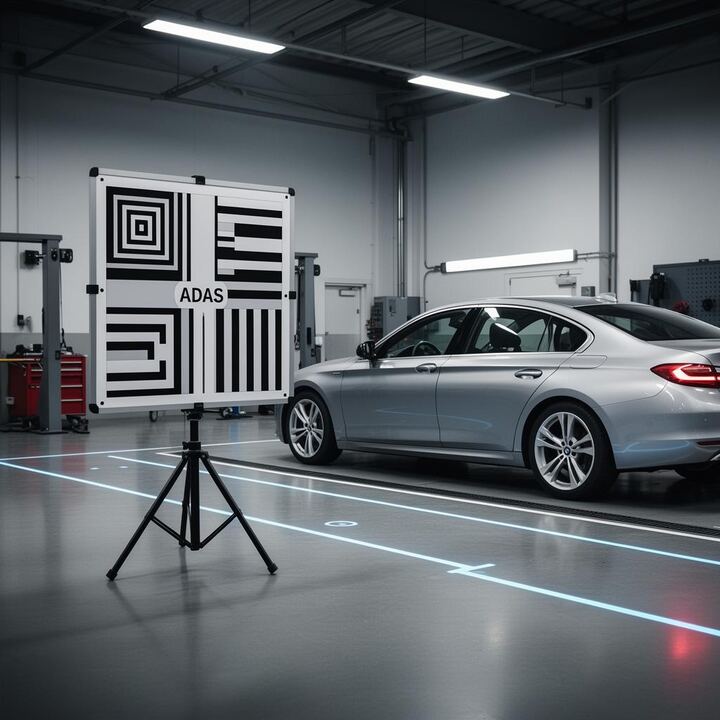
What does ADAS calibration actually mean?
ADAS stands for Advanced Driver Assistance Systems: the cameras, radar units, and ultrasonic sensors that run lane keeping, automatic emergency braking (AEB), adaptive cruise control, blind spot monitoring, and parking aids. Each of those sensors is aimed to a precise reference at the factory. Calibration is the service procedure that restores that aim after a collision repair, glass replacement, or suspension job disturbs it.
Calibration is not the same as a diagnostic scan. A scan reads and clears trouble codes. Calibration physically realigns the sensor. I-CAR, the collision-repair training authority, makes the distinction plainly: when a shop asks a dealer for "just a scan," the tech typically clears codes and returns the car as complete, but "in most cases the sensors/modules do not know they were replaced or that any calibration is required" (I-CAR RTS, The Differences Between Scanning and Calibration). A cleared code is not a calibrated sensor.
When does a vehicle need an ADAS calibration?
Calibration is driven by the repair operation, not by whether a warning light is on. The common triggers are a windshield replacement (which moves the forward-facing camera), front or rear bumper removal (which disturbs radar and parking sensors), a wheel alignment or suspension change (which shifts every fixed sensor's aim relative to the road), side mirror replacement on surround-view vehicles, and any collision repair near a sensor.
Manufacturers state this directly in their position statements. Subaru, for example, writes that "if windshield glass replacement is performed on a Subaru vehicle equipped with EyeSight, calibration is required after the windshield is replaced" (Subaru of America EyeSight position statement, 2017). Nissan requires the calibration procedure "after any ADAS component removal, replacement, and even vehicle alignment" (Nissan Collision Position Statement, 2026, via I-CAR RTS).
Why does a fraction of a degree matter so much?
Because a sensor's small aiming error becomes a large error far down the road. A forward camera or radar that is off by a single degree still reports itself as healthy, but it is looking at the wrong place. The geometry is simple. Lateral aim error grows with distance as
lateral error = d · tan θ
so a 1° error (tan 1° ≈ 0.0175) puts the aim about 1.75 feet off at 100 feet and roughly 17 feet off at 1,000 feet, about a full lane width. Industry calibration sources describe the same effect, noting a one-degree forward-camera misalignment produces a deviation of roughly 10 to 12 feet at 1,000 feet (Applied Automotive Technology). That is the difference between AEB braking for the car in your lane and braking for the one in the next lane, or not braking at all.
Static, dynamic, or both?
There are two calibration methods. A static calibration is done with the vehicle stationary, using physical targets placed at manufacturer-specified distances and angles in a controlled space. A dynamic calibration is done by driving the vehicle at set speeds over a set distance while the scan tool runs, so the sensor learns from real lane lines and traffic. Many modern vehicles require a static calibration first and then a dynamic one, in a specific order set by the manufacturer for that VIN. Which method applies is not a judgment call; it is looked up per vehicle in the OEM procedure.
Why calibration is not optional anymore
Two forces have made calibration a standard collision-repair operation rather than a rare add-on. First, the systems work: the Insurance Institute for Highway Safety found that low-speed AEB paired with forward collision warning cut front-to-rear crashes by 50 percent and front-to-rear injury crashes by 56 percent (IIHS). Second, regulators are requiring them: NHTSA's final rule FMVSS No. 127 will require automatic emergency braking, including pedestrian detection in daylight and darkness, on virtually all new light vehicles by September 2029 (NHTSA).
The result is visible in the repair data. According to CCC Intelligent Solutions, calibrations appeared on just 0.9 percent of repairable appraisals in 2017; by 2025 that share had passed 23 percent, and about a third of direct-repair claims now include one (CCC Intelligent Solutions, 2025). Calibration is now a routine line on the modern repair order, not an exception.
How Focal ADAS handles it
Focal ADAS performs static and dynamic ADAS calibrations on-site at collision shops across the Seattle to Tacoma corridor. Every job is scoped from the repair operations and the manufacturer's procedure for the specific VIN, and it ships with a pre-scan, a post-scan, the OEM procedure reference, and setup photos, so the calibration line is documented and defensible when the carrier reviews it.
Frequently asked questions
Is ADAS calibration the same as a wheel alignment?
No. A wheel alignment sets the suspension geometry. ADAS calibration re-aims the cameras and radar sensors. An alignment can actually be one of the triggers that requires a calibration afterward, because changing the vehicle's thrust angle or ride height moves how the sensors see the road.
Does every modern car need calibration after any repair?
No. Calibration is required when the specific repair operation disturbs a sensor or its reference, for example glass replacement, bumper removal, sensor replacement, or an alignment. A repair that does not touch an ADAS sensor or its mounting usually does not trigger one. The manufacturer's procedure for the VIN is what decides.
Can a shop tell a sensor is aimed correctly from a diagnostic scan?
No. A scan only reports stored fault codes. A camera or radar can be physically misaimed and still report no fault, because from the sensor's point of view it is working. Aim is confirmed only by completing the calibration procedure and capturing the pass result.
How long does an ADAS calibration take?
Most calibrations run about 30 to 90 minutes on-site, including setup and documentation, depending on the vehicle and whether the procedure is static, dynamic, or both.
Sources
- I-CAR RTS, "The Differences Between Scanning and Calibration." https://rts.i-car.com/crn-843.html
- Subaru of America, "Position Statement on Aftermarket Windshield Glass for Vehicles Equipped with EyeSight," 2017 https://www.oem1stop.com/sites/default/files/Subaru_Eyesight_Position_Revised(5-23-17).pdf
- Nissan, "Collision Position Statement, ADAS Components," 2026, via I-CAR RTS https://rts.i-car.com/crn-2388.html
- Applied Automotive Technology, "Precision in Alignment: The Geometry of Camera Calibration." https://appliedautomotivetechnology.com/blog/precision-in-alignment-the-geometry-of-camera-calibration
- Insurance Institute for Highway Safety, "Front crash prevention slashes police-reported rear-end crashes." https://www.iihs.org/news/detail/front-crash-prevention-slashes-police-reported-rear-end-crashes
- NHTSA, "FMVSS No. 127 Automatic Emergency Braking," final rule, April 29, 2024 https://www.nhtsa.gov/press-releases/nhtsa-fmvss-127-automatic-emergency-braking-reduce-crashes
- CCC Intelligent Solutions, "The Current State of Calibrations: A Turning Point for Collision Repair," 2025 https://www.cccis.com/news-and-insights/posts/the-current-state-of-calibrations-a-turning-point-for-collision-repair
Focal ADAS handles it on-site, same day, from Seattle to Tacoma.
Keep reading
Put calibration on autopilot.
Request a calibration in 60 seconds. A reply with an arrival window comes back within the hour.