Ford and Lincoln require calibration when an ADAS-related repair affects a sensor, its attachment, or a part in its field of view. Current OEM positions also require pre-repair and post-repair scans on damaged vehicles and calibration of affected components even without a trouble code. The exact workshop procedure decides the method and prerequisites.
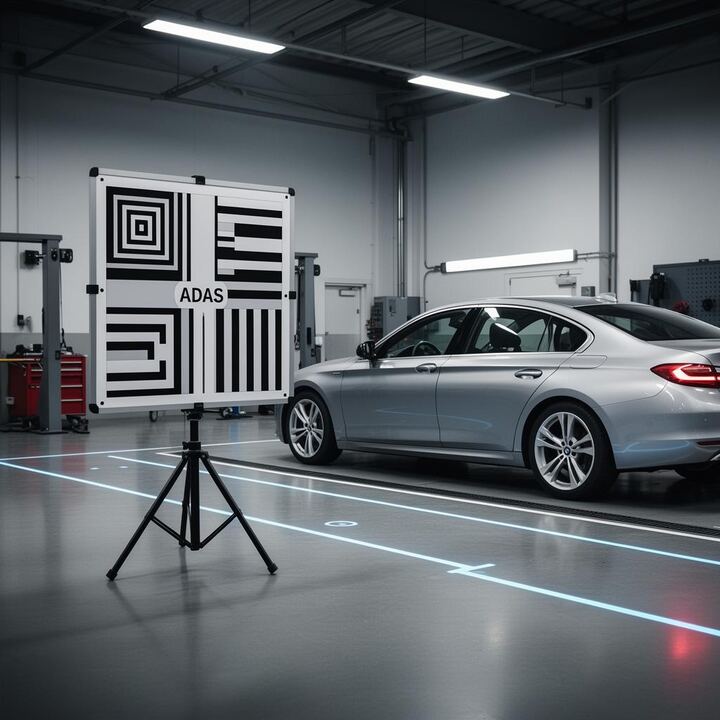
Ford and Lincoln require calibration when an ADAS-related repair affects a sensor, its attachment, or a part in its field of view. The current OEM position statements also require pre-repair and post-repair diagnostic scans for damaged vehicles and direct calibration of affected ADAS components even when no diagnostic trouble code is present.
For a collision estimator, that definition reaches beyond obvious sensor replacement. A bumper beam can support a sensor, a fascia can sit in front of one, and glass can form part of a camera's view. The repair plan has to connect each repair operation to the affected system before parts, labor, sublet timing, and documentation are finalized.
What does Ford count as an ADAS-related repair?
Ford's May 2026 position statement defines an ADAS-related repair as repair, replacement, or removal and installation of an ADAS sensor, a part that attaches or affects the position of a sensor, or a part in the sensor's field of view. It gives bumpers, quarter panels, brackets, grilles, and glass as examples within those categories. The Ford collision position statement is the controlling source for that broad screening rule.
Lincoln publishes the same three-part definition for its vehicles. Its statement separately identifies cameras, radars, and ultrasonic sensors, then extends review to supporting parts and field-of-view parts. The Lincoln collision position statement means an estimator should not wait for a replaced sensor to add an ADAS research line.
The blueprint should flag operations involving:
- A camera, radar, ultrasonic sensor, or related module.
- A bracket, bumper beam, quarter panel, mirror, or other sensor attachment.
- A fascia, grille, windshield, or other material within a sensor's view.
- Suspension, alignment, ride-height, or wheel and tire changes named by the vehicle procedure.
- A diagnostic instruction, service message, or workshop-manual trigger.
This is a research queue, not a universal trigger list. The exact vehicle workshop manual remains necessary because system content and event requirements differ across model years and configurations.
Is calibration still required when the dash has no warning?
Yes, when the repair meets the OEM's ADAS-related definition and affects a component. Ford requires calibration for affected components regardless of whether a diagnostic trouble code is present. The statement explains that some misaligned sensors may not immediately set a code. It also requires a pre-repair scan for all vehicles with damage even if no dashboard indicator appears, followed by a post-repair scan to confirm communication and check for new faults. Ford's published scan and calibration rules keep those operations separate.
Lincoln provides the same direction: a missing code does not cancel calibration for an affected ADAS component, and a missing warning does not cancel the pre-repair scan on a damaged vehicle. Lincoln's OEM statement makes a warning-lamp-only decision process incomplete.
That distinction matters on an estimate. The scan establishes diagnostic information. The calibration follows the OEM procedure to address the affected sensor or feature. One line should not be used as proof that the other operation was performed.
Does the Co-Pilot360 suite point to a single sensor?
No. Driver-assistance suite names describe groups of features, not one shared calibration operation. I-CAR's Ford and Lincoln research shows that named suites combine functions such as adaptive cruise control and lane keeping, with some configurations adding lane centering or traffic-sign functions. I-CAR's ADAS-suite explanation supports researching the affected camera and sensor paths individually.
For blueprinting, the estimator should identify the actual component location and the repair interaction. A forward camera behind the windshield creates different planning questions from a cruise sensor behind the front fascia or a side camera attached to a mirror. The suite name is useful for discovery, but it does not state the workspace, sequence, prerequisites, or result record.
Which vehicle-specific triggers show why the VIN matters?
I-CAR's 2023 Lincoln Nautilus calibration record gives a concrete example. For the camera near the rearview mirror, it lists front-airbag deployment, camera removal or replacement, suspension repair or alignment, tire-size change, and windshield removal or replacement among the calibration events. For the sensor behind the front bumper, it lists sensor or bracket removal and replacement, a collision event, and indicated diagnostic conditions. The I-CAR vehicle-specific record also shows that other parking sensors on the same vehicle can call for operation checks rather than calibration.
That single vehicle demonstrates why broad language such as "calibrate all sensors" is not a defensible repair plan. Different components on one vehicle can have different required outcomes:
- Calibration or initialization after a listed repair event.
- An operation check even when no calibration requirement is identified.
- Diagnostic work when a trouble code indicates a fault.
- No identified calibration event for a particular component, subject to the current OEM procedure.
The estimate should preserve those differences and cite the procedure used for each decision.
What belongs on the estimate before the vehicle reaches calibration?
A complete plan identifies the system, sensor location, affected repair operation, prerequisite mechanical or body work, calibration method, scan work, and final verification. Ford and Lincoln both direct repairers to the workshop manual for calibration procedures and component locations. The Ford statement and the Lincoln statement make current OEM information part of the decision.
Focal ADAS recommends that the handoff include:
- VIN and complete repair order.
- Parts repaired, replaced, removed, installed, or adjusted.
- Glass, suspension, alignment, wheel, tire, and structural operations.
- Pre-repair diagnostic findings and any unresolved faults.
- Confirmation that refinish, assembly, and geometry-changing work is complete.
- The requested calibration and any separately identified operation check.
This information reduces late discovery. It also gives the calibration provider enough context to challenge a missing operation or avoid performing an operation that does not match the current vehicle procedure.
How should a shop schedule Ford or Lincoln mobile work?
Calibration should follow repairs that can alter sensor position, attachment, field of view, or vehicle geometry. A windshield camera job should not be booked before the glass and bracket condition are final. A front sensor job should not be closed while bumper, grille, mounting, or alignment work remains open.
The forward camera calibration service fits windshield and camera-centered work. The front radar calibration service fits front-sensor planning, and steering angle reset provides context when alignment work creates a separate initialization requirement. Shops comparing scans with calibration can also review why a clean scan is not a calibration.
Focal ADAS coordinates mobile calibration for collision shops along the Seattle to Tacoma corridor. The shop can send the VIN and repair scope to service@focaladas.com or call (206) 460-0999 for scheduling.
Frequently asked questions
Does Ford require calibration when no diagnostic trouble code is present?
Yes, when an ADAS-related repair affects the component. Ford's current position statement says affected components require calibration regardless of a diagnostic trouble code because some misaligned sensors may not immediately set one.
Are pre-repair and post-repair scans required on damaged Ford and Lincoln vehicles?
The 2026 Ford and Lincoln position statements require a pre-repair diagnostic scan for vehicles with damage and a post-repair scan to confirm system communication and identify newly introduced faults. Those scan records remain separate from calibration evidence.
Can windshield or alignment work trigger a Ford or Lincoln camera calibration?
Yes, on applications whose vehicle procedure lists those events. I-CAR's 2023 Lincoln Nautilus record includes windshield removal or replacement and suspension repair or alignment among the forward-camera calibration events, but every VIN needs current procedure confirmation.
Does the Co-Pilot360 suite identify one calibration operation?
No. I-CAR describes Ford and Lincoln suite names as combinations of driver-assistance functions. The estimator still has to identify the affected camera or sensor, component location, repair event, and vehicle-specific procedure.
When should a Ford or Lincoln mobile calibration be scheduled?
Scheduling should follow completion of work that can alter sensor position, attachment, field of view, glass location, or vehicle geometry. The shop should send the VIN, complete repair scope, scan findings, and assembly status before the appointment.
Sources
- Ford 2026 ADAS Integrity and Repair Technical Imperatives position statement https://rts.i-car.com/images/pdf/oem-info/ford/statements/85186.pdf
- Lincoln 2026 ADAS Integrity and Repair Technical Imperatives position statement https://rts.i-car.com/images/pdf/oem-info/lincoln/statements/85187.pdf
- I-CAR Ford and Lincoln ADAS suite calibration research https://rts.i-car.com/crn-1684.html
- I-CAR OEM Calibration Requirements Search for 2023 Lincoln Nautilus https://rts.i-car.com/calv-4580.html
Focal ADAS handles it on-site, same day, from Seattle to Tacoma.
Put calibration on autopilot.
Request a calibration in 60 seconds. A reply with an arrival window comes back within the hour.