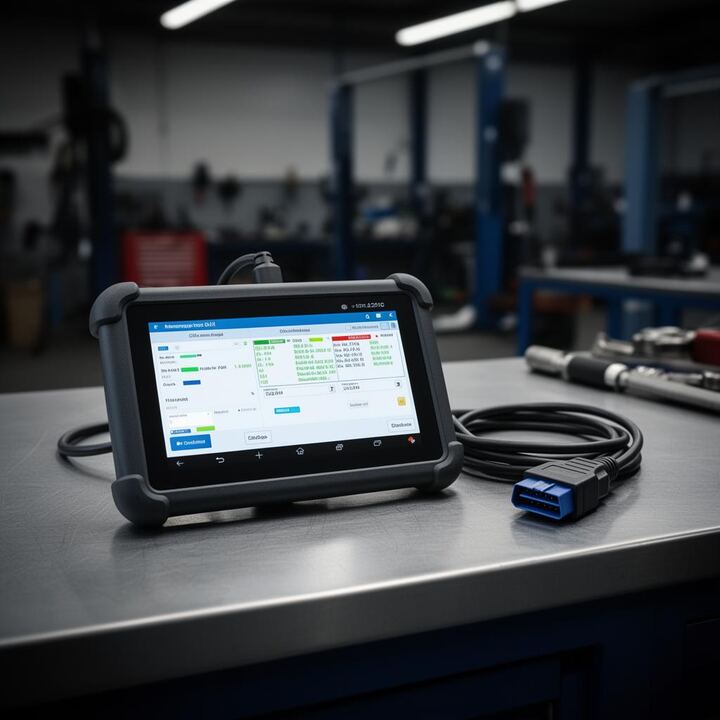
A diagnostic scan reads and clears fault codes. It does not tell you whether a camera or radar is aimed correctly. A sensor can be knocked out of alignment in a repair and still report no fault, because from its point of view it is working. That is why manufacturers require calibration based on the repair performed, not on whether the scan comes back clean.
Does a clean scan mean the calibration is done?
No, and this is the single most costly misunderstanding on the estimating side. A scan and a calibration are different operations. A scan interrogates the vehicle's modules and reports the trouble codes they have stored. A calibration physically re-aims a sensor to the manufacturer's reference. I-CAR, the collision-repair training authority, puts it plainly: when a shop asks for "just a scan," the codes get cleared and the car is returned as complete, but "in most cases the sensors/modules do not know they were replaced or that any calibration is required" (I-CAR RTS). A cleared code is not a calibrated sensor.
Why a misaimed sensor stores no code
A camera or radar checks itself for electrical faults, not for physical aim. If the sensor powers up, communicates, and sees a plausible image, it reports no fault, even if the bumper or glass it is mounted behind moved a degree or two during the repair. The manufacturers say this in their own words. Honda notes that "these driver assistive systems often will not display DTCs during a vehicle scan unless there is damage to the applicable system, so aiming and/or calibration may be required" (American Honda). Ford is more pointed still: "Certain ADAS sensors may not immediately trigger a DTC if misaligned. Failure to calibrate could result in a vehicle leaving the repair facility with compromised or inoperative ADAS features" (Ford Motor Company).
What this means for scoping the work
Because a scan cannot confirm aim, the calibration has to be scoped from the repair operations. If the operation removed or disturbed a sensor, its mounting panel, or the glass it sits behind, or realigned the suspension, then the affected system is on the calibration list regardless of what the post-scan shows. The scan still matters, it brackets the repair and proves no new faults were introduced, but it is evidence of module health, not proof of correct aim.
Using this to get the line paid
This distinction is exactly the argument that gets a contested calibration approved. When an adjuster pushes back with "the scan is clean," the answer is not an opinion, it is the manufacturer's own language: the sensor can be misaimed without a code, so the OEM requires calibration based on the operation. A calibration file that pairs that manufacturer position with the calibration pass result and a pre-scan and post-scan leaves nothing to argue about. This is why calibrations now appear on more than 23 percent of repairable appraisals, up from under 1 percent in 2017 (CCC Intelligent Solutions, 2025): the documentation standard has caught up with the technology.
Frequently asked questions
If the post-scan is clean, why do I still need a calibration line?
Because a clean post-scan only proves no fault code is stored. It does not prove the sensor is aimed to specification. They are separate operations, so the calibration is a separate, documented line item.
How do I answer an adjuster who says the scan shows no problem?
Point to the manufacturer position. Honda and Ford both state in writing that ADAS sensors can be misaligned without setting a code, so calibration is required based on the repair, not the scan. That published language is what supports the line.
Does every scan need a calibration?
No. A calibration is required only when the repair disturbed a sensor or its reference. A scan on a repair that touched no ADAS component may need no calibration at all. The operations decide.
Sources
- I-CAR RTS, "The Differences Between Scanning and Calibration." https://rts.i-car.com/crn-843.html
- American Honda, "Post-Collision Diagnostic Scan and Calibration Requirements," 2024 https://www.oem1stop.com/sites/default/files/Honda-Acura_Pos_Diag-Scans-Calib_Revised_FINAL(3-24).pdf
- Ford Motor Company, "Collision Repair Position Statement," 2025 https://www.oem1stop.com/sites/default/files/FORD%20Position%20Statement%20ADAS%20Scanning%20-%20FNL%20(9-30-25).pdf
- CCC Intelligent Solutions, "The Current State of Calibrations," 2025 https://www.cccis.com/news-and-insights/posts/the-current-state-of-calibrations-a-turning-point-for-collision-repair
Focal ADAS handles it on-site, same day, from Seattle to Tacoma.
Keep reading
Put calibration on autopilot.
Request a calibration in 60 seconds. A reply with an arrival window comes back within the hour.