Kia ADAS calibration requirements vary by model, installed component, and repair event. Windshield or camera work, radar removal or replacement, collision damage near a sensor, steering-angle work, bumper refinishing, and specified trouble codes can change the plan. Some replacement cameras also require configuration, calibration, and a final diagnostic check in a defined sequence.
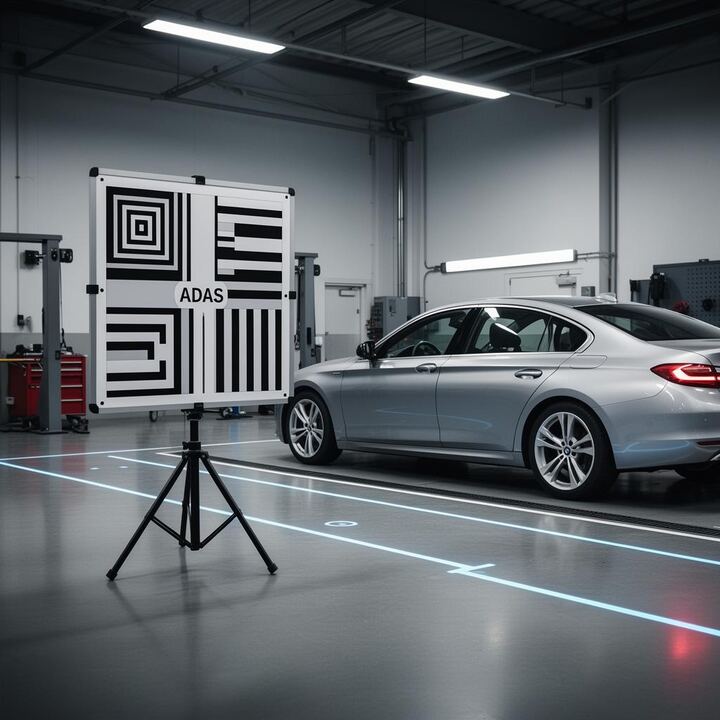
Kia ADAS calibration requirements vary by model, installed driver-assistance components, and the exact repair event. Forward-camera work, front or rear radar work, windshield replacement, bumper damage, bracket condition, diagnostic faults, and some steering-related operations can lead to different procedures. The estimator should research the component and location, not write from a suite name alone.
Kia repairs also demonstrate why calibration cannot be treated as one isolated sublet. A replacement camera can require saved configuration data, coding, calibration, and a final diagnostic check. Rear-bumper refinishing may be restricted around a radar field even when the sensor itself is not replaced. A complete plan identifies each operation before the vehicle enters reassembly.
Which Kia systems can share camera, radar, and braking inputs?
I-CAR's Kia blind-spot system research notes that Kia uses more than one blind-spot system name and that some functions use both the windshield camera for lane markings and side or rear radar for surrounding traffic. The same guidance says related stability-control or braking faults can make a driver-assistance function unavailable.
That interaction matters during collision blueprinting. A complaint in one feature may lead the shop to several components or systems, while a damaged shared input may affect more than the feature named on the assignment. The repair plan should therefore identify:
- The exact system fitted to the VIN.
- Every camera, radar, bracket, and related input affected by the repair.
- Whether braking, steering, or stability-control faults block calibration or function.
- The OEM-required calibration, coding, diagnostics, and operation check.
System names help the shop find the right manual section. They do not establish a universal calibration method.
Why can Kia camera replacement require a sequence of operations?
A NHTSA-hosted Kia bulletin covering specified 2019-2022 Niro, 2021-2022 Seltos, 2020-2021 Soul, 2019-2022 Sportage, and 2020-2022 Telluride applications gives a precise example. Its front-camera replacement workflow calls for recovering the previous coding value, completing variant coding, performing any directed software step, calibrating the camera, checking diagnostic trouble codes, and confirming normal operation. The Kia camera bulletin should be applied only to its stated vehicles and conditions.
For the estimate, the important lesson is the operation order. A replacement line does not automatically include configuration, and geometric completion cannot establish that the stored vehicle variant is correct. The file should show which values were handled, what coding was completed, what calibration procedure ran, what faults remained, and how operation was confirmed.
This sequence also affects scheduling. The vehicle should reach calibration with the replacement component installed, blocking faults addressed, glass and brackets final, and any prerequisite configuration available. If the procedure calls for a software step before calibration, production should not book the calibration as though it were the first electronic operation.
How do Kia camera and radar triggers differ on one vehicle?
The 2021 Kia Rio calibration record shows component-level differences on one application. Its camera entry covers removal, reinstallation, replacement, a distorted mounting bracket, specified trouble codes, and windshield removal or replacement. It also identifies programming when a new camera is installed.
The same record gives the front radar a different trigger set, including specified trouble codes, failure to detect a vehicle ahead, sensor removal or replacement, an impact involving the radar area, and steering-angle sensor replacement or calibration. A new radar may also require programming. Rear-corner radar requirements are narrower and include specified diagnostic conditions plus sensor, bracket, or wiring replacement.
These are 2021 Rio examples, not make-wide instructions. They demonstrate why the estimate should name the component location and event. "ADAS calibration" is too vague when the forward camera, front radar, and rear-corner radars have different prerequisites and completion records.
What Kia rear-bumper repair details can change the plan?
I-CAR's Kia bumper-cover guidance reports vehicle-service restrictions around rear-corner radar. The guidance warns against foreign material near the radar, notes that paint repair and iron-containing putty can affect sensing, and directs inspection of the sensor and bracket after impact or displacement.
For a rear-impact estimate, the shop should document the bumper condition before choosing repair, refinish, or replacement. The plan should identify the sensor field, prior repairs, filler or coating concerns, bracket position, wiring condition, and current vehicle procedure. A calibration decision belongs after those repair choices are settled, not as an automatic add-on detached from the fascia work.
An earlier 2019 Kia Sportage ADAS review further illustrates component variation. That vehicle could include a forward camera, front radar, rear-corner radars, rear-view camera, and ultrasonic sensors, with different calibration findings for the different components. Model-range examples should guide research, never replace it.
What scans and handoff records does Kia require?
Kia scanning guidance reported by I-CAR says pre-repair and post-repair scans are imperative after a collision and notes that diagnostic trouble codes may exist without a warning lamp, including after minor repairs. The scan should establish a baseline, identify blocking conditions, and show the post-repair electronic state.
The final file should also identify the VIN, exact system and component, triggering repair, source procedure, programming or coding status, calibration method, result, and functional check. A post-repair scan supports that record but does not prove that a required geometric calibration occurred.
Windshield and camera work can be routed to forward camera calibration. Front-impact work belongs with front radar calibration, and rear-corner damage can be screened through blind spot radar calibration. Shops can also review bumper replacement and radar calibration while writing the repair plan.
For scheduling, the shop should send the VIN and repair context to service@focaladas.com or call (206) 460-0999. Focal ADAS confirms the current OEM procedure, calibration method, and site requirements before the appointment.
Frequently asked questions
Does every Kia camera replacement require the same steps?
No. A Kia bulletin for specified model and year ranges shows a sequence that can include coding recovery, variant coding, a directed software step, calibration, a trouble-code check, and functional confirmation. Other vehicles require their own current service procedure.
Can Kia steering work trigger front-radar calibration?
It can on an application whose procedure names that event. The 2021 Kia Rio record includes steering-angle sensor replacement or calibration among front-radar triggers, but that example must not be applied to another Kia without VIN-specific confirmation.
Can bumper filler or refinish material affect a Kia rear radar?
Yes. Kia guidance reported by I-CAR warns that foreign material, paint-repair conditions, and iron-containing putty near a rear-corner radar may affect sensing. The shop should inspect the sensor field and bracket before finalizing the bumper repair decision.
Does a Kia require scanning when no warning light is on?
Kia guidance reported by I-CAR calls for pre-repair and post-repair scans after collision work and notes that stored faults may not illuminate a warning lamp. Scan results remain distinct from coding, calibration, and operation-check evidence.
What should a shop provide before Kia mobile calibration?
The shop should provide the VIN, full repair order, camera and radar locations, windshield and bracket status, bumper repair details, steering or alignment work, replacement-component information, and diagnostic findings. That handoff supports accurate procedure and schedule confirmation.
Sources
- I-CAR Kia blind-spot system research https://rts.i-car.com/crn-1370.html
- I-CAR Kia bumper-cover repair guidance for ADAS https://rts.i-car.com/crn-1491.html
- I-CAR 2019 Kia Sportage ADAS research https://rts.i-car.com/crn-1228.html
- NHTSA-hosted Kia front-camera replacement bulletin https://static.nhtsa.gov/odi/tsbs/2021/MC-10200524-0001.pdf
- I-CAR OEM Calibration Requirements Search for 2021 Kia Rio https://rts.i-car.com/calv-4022.html
- I-CAR Kia pre-repair and post-repair scanning guidance https://rts.i-car.com/crn-868.html
Focal ADAS handles it on-site, same day, from Seattle to Tacoma.
Put calibration on autopilot.
Request a calibration in 60 seconds. A reply with an arrival window comes back within the hour.