Rivian ADAS calibration requirements differ between 2022 through 2024 first-generation R1 vehicles and 2025 and later second-generation vehicles. Camera, radar, windshield, fascia, coding, and alignment conditions vary by component. Shops must also verify current Rivian provider eligibility and service access before assigning calibration work.
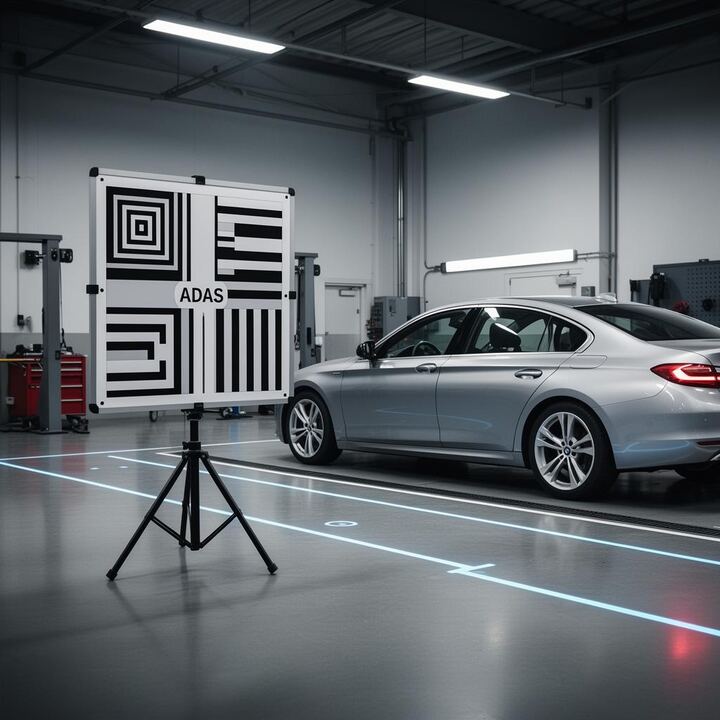
Rivian ADAS calibration planning must begin with the vehicle generation, installed camera and radar arrangement, actual repair event, and current service information. Rivian separates 2022 through 2024 first-generation R1 vehicles from 2025 and later second-generation vehicles, and the sensor architecture and trigger details differ. The current service manual supersedes summary guidance, so a shop should never apply a first-generation instruction to a later configuration by assumption.
Rivian's February 2025 position statement also places restrictions on who should perform repairs and calibrations involving its driver-assistance systems. A collision shop must verify current provider eligibility, service access, and procedure availability before assigning the work. No scheduling statement should imply authorization that has not been confirmed. Rivian's ADAS calibration position statement is the controlling primary source for that limitation and the generation-specific overview.
How do first-generation and second-generation Rivian systems differ?
The Rivian position statement divides R1T and R1S vehicles into 2022 through 2024 first-generation applications and 2025 and later second-generation applications. It identifies different camera and radar arrangements for those generations and then lists component-specific calibration events. The February 2025 Rivian statement supplies the exact ranges.
For an estimator, that means the model name alone is not enough. The repair plan should record the model year and identify the affected component by its position and procedure name. A generic line for all cameras or all radars can miss a generation-specific trigger or combine separate operations.
The statement is a planning guide, not the final repair instruction. It says the current service manual supersedes the summary. The shop should use the guide to recognize likely research points, then document the exact procedure retrieved for the VIN and current vehicle configuration.
When does Rivian require camera calibration research?
Rivian identifies the driver-assistance front camera as a calibration concern after camera or windshield removal and replacement. For 2025 and later vehicles, the statement adds generation-specific front long-range, front wide-angle, side-mirror, and lane-change camera events with their own triggers. It also separates surround-view camera procedures. Rivian's ADAS position statement details those components and events.
The glass position is equally important. Rivian states that approved glass and adhesives should be used and warns that nonapproved products can contribute to camera calibration failure. It directs repairers back to current service-manual procedures after glass replacement. Rivian's glass replacement position statement supports those requirements.
I-CAR's earlier make-specific research for 2020 through 2024 vehicles also identifies the forward camera near the rearview mirror and says calibration is required following windshield replacement. I-CAR CRN-2170 gives that model-year context and procedure path. The current Rivian statement remains the better source when a later vehicle or generation-specific issue is involved.
Which radar and fascia events can change the repair plan?
Rivian's statement says the front-center radar requires calibration after sensor removal and installation or replacement, front-fascia replacement, and front-fascia refinishing. It also makes a narrower distinction for upper-fascia removal and installation when the radar angle has not changed. For 2022 through 2024 vehicles, newly installed radar units can require variant coding, while a removed and reinstalled unit does not require that coding under the stated condition. The Rivian ADAS statement is the source for each of those distinctions.
The same document defines a no-repair zone in front of the center radar. Only clearcoat work is allowed in that zone, and the bumper must be replaced if more repair is needed there. I-CAR's make-specific summary independently highlights that front-fascia restriction. I-CAR CRN-2102 provides the repair-planning reference.
This creates at least three separate estimate decisions: whether the fascia is repairable, whether the radar mounting position was disturbed, and whether the radar needs calibration or coding. A calibration result cannot make an impermissible fascia repair acceptable, and coding does not prove physical aim.
Does every Rivian calibration require a wheel alignment first?
No. Rivian's position statement says wheel alignment must be within specification for calibration, but it does not state that every vehicle automatically needs an alignment before every calibration. Rivian's ADAS statement makes that distinction.
The shop should inspect the repair facts and current procedure. Suspension, wheel, tire, steering, structural, ride-height, or impact conditions can justify alignment measurement or correction. When alignment is already within specification and the procedure does not call for a new alignment operation, adding one only because a calibration is scheduled would overstate the requirement.
The repair file should show how alignment readiness was established. If geometry is outside specification, correction should occur before aiming whenever the procedure uses that geometry as a reference.
Why are scans separate from calibration?
Rivian's collision-repair position calls for pre-repair and post-repair scanning and explains that collision damage can create nonvisual electronic faults. I-CAR CRN-2100 reproduces the make-specific scanning position.
Those scans help establish diagnostic condition and closeout, but they do not prove that a camera or radar unit is physically aimed. The calibration result must identify the component, procedure, and outcome. Likewise, a completed calibration does not replace a required post-repair scan or resolve unrelated faults.
What should be confirmed before assigning the work?
The shop should first verify that the requested provider is permitted to perform the operation under current Rivian policy and has legitimate access to the controlling procedure. That eligibility check is a gate, not a marketing claim. If it cannot be confirmed, the job should be referred through an appropriate Rivian channel rather than promised.
After eligibility is verified, readiness should be recorded by Rivian generation and component position. The named windshield, fascia zone, camera, radar, bracket, and mount must be final under the current service instruction. Alignment must be within specification where the statement requires it, while tire state, vehicle height, and diagnostic repair must support the selected operation.
The assignment packet should state first-generation or second-generation status, the precise sensor location, the event affecting it, the fascia or glass decision, any new-part coding requirement, and the source procedure. That information makes it possible to accept, refer, or place the request on hold without making an unsupported authorization claim.
Why should Rivian camera, radar, and ultrasonic work remain separate?
Rivian's current position statement is component-specific. It distinguishes the driver-assistance front camera, generation-specific front and side cameras, surround-view cameras, front-center radar, and other radar locations rather than treating the vehicle as one calibratable system. The February 2025 statement also says that ultrasonic sensors do not require calibration, while noting that the service manual remains controlling.
That distinction changes estimating. A shop should not create one line that promises to calibrate every sensor after a collision. The repair plan should identify the exact camera or radar position, the event affecting it, and the generation-specific instruction. An ultrasonic sensor replacement can require installation checks or diagnosis without becoming a calibration line merely because it supports a driver-assistance feature.
The same precision applies to radar coding. For the statement's 2022 through 2024 condition, a newly installed radar can require variant coding, while a removed and reinstalled radar does not require that coding under the stated condition. Coding establishes electronic configuration. Calibration establishes the physical or learned reference. A scan reports diagnostic status. The three results should remain individually visible.
Before dispatch, the estimator can use a five-part Rivian gate:
- Confirm model year and first-generation or second-generation status.
- Name the affected camera, radar, fascia zone, or windshield operation.
- Verify provider eligibility and access to the current procedure.
- Confirm the physical prerequisites, including fascia repairability and alignment within specification where required.
- Request separate statuses for scanning, coding, calibration, and any functional verification.
If any gate is unconfirmed, the work should not be represented as a routine mobile appointment. The result can be an eligibility referral, a procedure-research hold, or a repair-readiness blocker without implying that the shop or provider failed a calibration.
What belongs in the Rivian repair file?
The file should retain the generation and component identification, OEM procedure, repair trigger, provider-eligibility confirmation where required, prerequisites, method, result, and any unresolved limitation. Calibration, coding, scanning, fascia repair, glass installation, and functional checks should remain separately named.
Related resources include ADAS calibration after a collision, windshield-related calibration research, forward-camera calibration, front-radar calibration, and surround-view camera calibration.
For a make-specific calibration request, a shop can send the VIN and repair details to service@focaladas.com or call (206) 460-0999. Focal ADAS confirms the applicable procedure, vehicle readiness, and scheduling before the visit.
Frequently asked questions
Are 2022 through 2024 and 2025 and later Rivian procedures the same?
No. Rivian separates first-generation and second-generation R1 vehicles and identifies different camera and radar arrangements and triggers. The model year and current service manual must be verified before work is assigned.
Can any mobile provider perform Rivian ADAS calibration?
A shop should not assume that. Rivian’s position statement restricts who should perform ADAS repairs and calibrations, so current provider eligibility, service access, and the controlling procedure must be confirmed before scheduling.
Does every Rivian calibration require a new wheel alignment?
No. Rivian says alignment must be within specification, but its position statement does not require a new alignment for every calibration. Repair facts and the current procedure determine whether measurement or correction is needed.
Can a Rivian front fascia be repaired in front of the center radar?
Rivian defines a no-repair zone in front of the center radar and limits that area to clearcoat work in its position statement. More extensive work in the stated zone requires the bumper decision identified by the current OEM guidance.
What should a Rivian calibration file separate?
The file should separately identify generation, camera or radar component, fascia or glass repair, scanning, variant coding, alignment readiness, calibration, provider eligibility where required, and the result or blocker.
Sources
- Rivian, RCI-86-22-001-8: Advanced Driver Assistance System Calibration Requirements and Best Practices, R1T and R1S https://rts.i-car.com/images/pdf/oem-info/rivian/position-statements/71346x.pdf
- Rivian, RCI-52-23-003-2: Windshield and Glass Replacement https://rts.i-car.com/images/pdf/oem-info/rivian/position-statements/71351x.pdf
- I-CAR, Rivian Glass Replacement Requirements, CRN-2170 https://rts.i-car.com/crn-2170.html
- I-CAR, Rivian Position Statement: Pre- And Post- Repair System Scanning, CRN-2100 https://rts.i-car.com/crn-2100.html
- I-CAR, Bumper Cover Repair With ADAS: Rivian, CRN-2102 https://rts.i-car.com/crn-2102.html
Focal ADAS handles it on-site, same day, from Seattle to Tacoma.
Put calibration on autopilot.
Request a calibration in 60 seconds. A reply with an arrival window comes back within the hour.